The Story between Our Customer and Kaiyubang
7m Wrought Iron Sliding Gates | Kaiyubang Project
See Kaiyubang assemble and test two custom wrought iron sliding gates over 7m wide, with forged iron, hot-dip galvanizing and an oven-cured finish.

Some gates look impressive in a drawing. But the real test comes when the finished structure is assembled, placed on its track and moved for the first time.
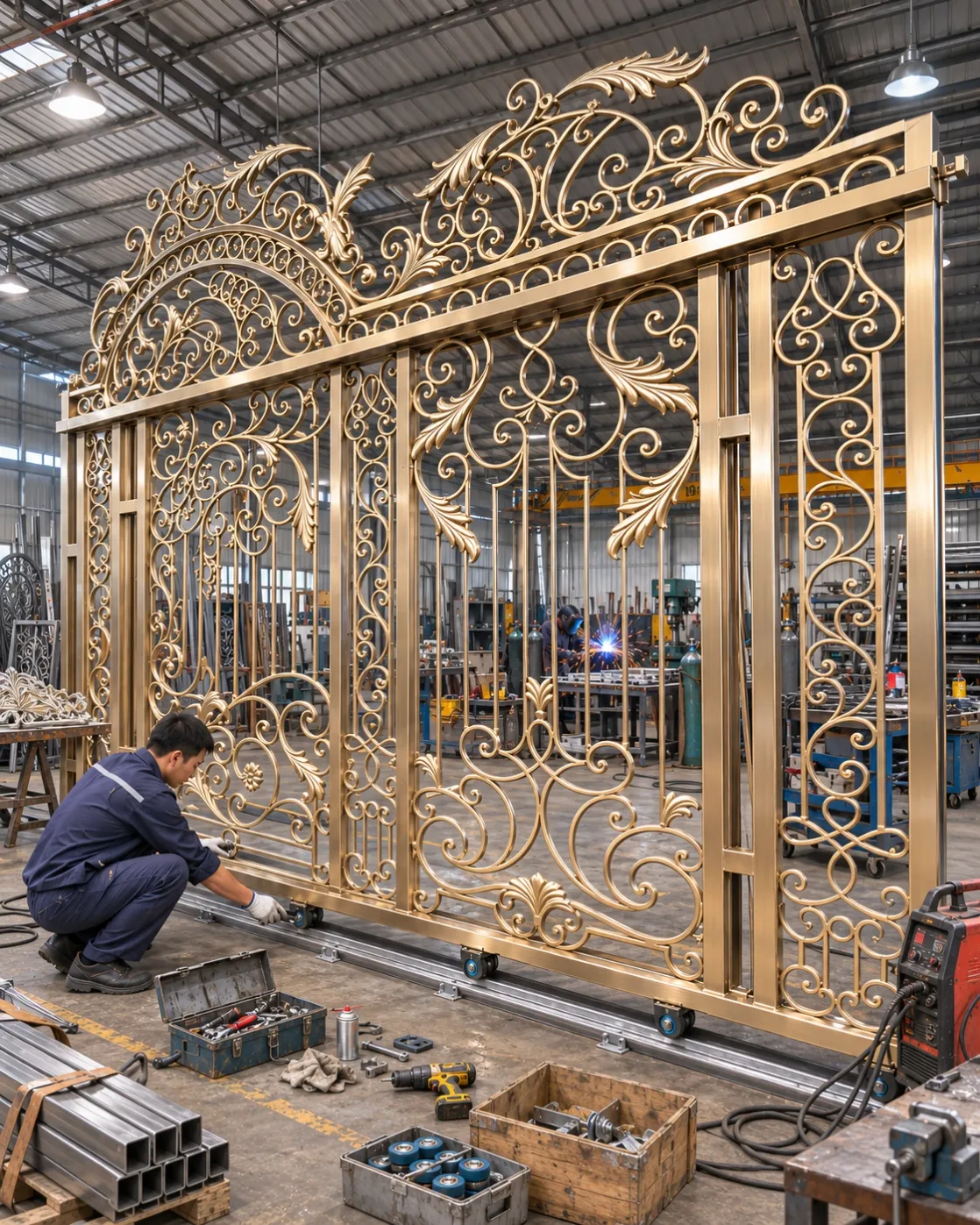
This week, Kaiyubang completed the pre-shipment assembly and trial testing of two matching custom wrought iron sliding gates. With a span exceeding 7 meters and a height close to 4 meters, these are large architectural structures made with solid forged iron components. Our craftsmen spent three days assembling the gates. Today, both sets were ready for trial fitting, with the tracks, rollers and electric motors installed and tested.
And there was one detail we were particularly pleased with: despite their impressive size and weight, the gates could move smoothly with just one hand.
Two Custom Wrought Iron Sliding Gates, Three Days of Assembly
When the two matching gates arrived at the assembly stage, the workshop team had an important task ahead.
These were not ordinary residential driveway gates. Their large dimensions and solid forged iron construction required careful assembly and alignment.
Our craftsmen spent three full days bringing the components together, checking the connections and making adjustments to ensure that the two gate sets matched the original design.
For a project of this scale, assembly is about much more than connecting individual metal sections. Every component needs to fit correctly, and the overall structure must remain balanced.
Even a small alignment error can become a problem when a sliding gate spans more than 7 meters.
That is why we prefer to carry out a trial assembly before shipment whenever the project requires it.
Solid Forged Iron Construction for Large Metal Gates
The visual impact of these gates comes from their substantial iron construction.
Unlike lightweight decorative gate panels, this project uses solid forged iron components to create a strong, substantial architectural appearance.
For large custom wrought iron gates, material selection and structural design need to work together.
Important considerations include:
- Material strength: The iron sections must be suitable for the dimensions and structural requirements of the gate.
- Connection quality: Welding and assembly points need to be properly finished and checked.
- Structural alignment: The two gate assemblies must maintain their intended geometry.
- Weight distribution: The gate structure must work correctly with the rollers, track and supporting system.
- Surface protection: Outdoor metalwork requires an appropriate anti-corrosion treatment.
A large wrought iron driveway gate should not simply look strong. Its construction, supporting components and movement system must all be designed as one complete solution.
Hot-Dip Galvanizing and Oven-Cured Paint for Outdoor Protection
Large outdoor gates are exposed to rain, moisture, temperature changes and other environmental conditions.
For this project, we selected a two-stage surface protection system: hot-dip galvanizing followed by an oven-cured paint finish.
Why hot-dip galvanizing?
Hot-dip galvanizing creates a zinc coating over the steel surface. This coating provides both a physical barrier and sacrificial corrosion protection.
It helps protect the underlying metal against corrosion, including in areas where the exterior coating may become damaged.
Why add a paint finish?
The second stage provides an additional protective layer and the required architectural appearance.
The paint finish also gives the gate a consistent surface colour and a refined final look.
This combination is commonly known as a duplex coating system.
According to the American Galvanizers Association, combining hot-dip galvanizing with paint or powder coating can provide better corrosion protection and longer maintenance intervals than using either system alone.
For this project, the intended protection target is 20+ years under suitable exposure and maintenance conditions. Actual service life depends on the zinc coating thickness, paint preparation, installation environment and ongoing maintenance.
For buyers planning large outdoor wrought iron sliding gates, it is important to discuss the complete coating specification rather than choosing a finish based on colour alone.
The Track and Roller Test: Can One Person Move Such a Large Gate?
This was one of the most satisfying moments of the entire project.
After the gate assembly was completed, we installed the track and roller system for trial testing.
The electric motor was also installed, and the operating system was adjusted.
Then came a simple but important test.
We placed the gate on the track and checked how smoothly it moved.
Despite its enormous dimensions, one person could push the gate with just one hand.
Why does this matter?
A large sliding gate depends on more than the strength of its iron frame. The track, rollers, guide components and overall alignment all influence its movement.
If the track is not straight, if the rollers are incorrectly adjusted, or if the gate is not properly aligned, unnecessary resistance can develop.
For this reason, our trial assembly includes several checks:
- Track alignment: The track needs to be correctly positioned and securely installed.
- Roller adjustment: The rollers must support the gate evenly and move without unnecessary friction.
- Gate balance: The gate should travel smoothly without excessive tilting or lateral movement.
- Opening and closing clearance: The structure should move without rubbing against surrounding components.
- Motor operation: The motor, drive components and travel limits need to be adjusted and tested.
A smooth manual movement test is a useful indication of correct mechanical adjustment, although it does not replace a full powered operation and safety check.
The sliding gate installation guide also highlights the importance of track positioning, roller adjustment and checking the gate throughout its opening and closing travel.
Why Trial Assembly Before Shipment Matters
For custom architectural gates, shipping directly after fabrication without checking the assembled structure can create unnecessary installation risks.
Our approach is to assemble and test the gate before it leaves the workshop whenever the project requires it.
For this order, the pre-shipment trial assembly allowed us to:
- Check the overall dimensions and assembly.
- Confirm the two matching gate sets were correctly fitted.
- Install and adjust the track and rollers.
- Fit the electric motor and test the operating system.
- Identify potential alignment issues before delivery.
- Record the trial process for the customer.
Once the testing was completed, we filmed the results and sent the video to the customer.
This gives the buyer a clearer understanding of the finished product before it arrives at the installation site.
For international projects, this step is particularly valuable because the customer and manufacturer may be thousands of kilometres apart.
Supporting Installation After Delivery
A successful factory trial is only part of the project.
The gates still need to be installed correctly at the customer's location.
To make this easier, we also provided the customer with a video showing the trial assembly and adjustment process.
This allows the installation team to refer to the actual gate structure, track arrangement and adjustment details when preparing for installation.
Before final installation, the site team should check:
- Foundation and track positioning.
- Ground level and track straightness.
- Supporting posts and fixing points.
- Roller and guide clearances.
- Motor installation and electrical connections.
- Limit switches, safety sensors and emergency operation.
The final installation must also follow the motor manufacturer's instructions and applicable local safety requirements.
We believe that supplying a custom gate should involve more than manufacturing and shipping. Clear technical communication between the factory and installation team is also important.
Looking for a Custom Wrought Iron Sliding Gate Manufacturer?
A large architectural gate requires careful coordination between design, material selection, fabrication, surface treatment and mechanical adjustment.
At Kaiyubang, we work with customers on customized architectural metalwork, including wrought iron gates, driveway gates, decorative metal gates and staircase railings.
Whether your project requires a large sliding entrance gate, a traditional ornamental design or a completely customized architectural feature, we can discuss your drawings, dimensions, materials and finish requirements.
Have a large gate project in mind?
Send us your drawings, reference photographs and required dimensions. Our team can help review the design and discuss a suitable manufacturing solution.
Visit Kaiyubang's custom decorative metal gates collection or contact our team for a custom gate quotation.
At Kaiyubang, we believe that a well-made gate should do more than create an impressive entrance. It should also move smoothly, perform reliably and stand up to years of outdoor use.